The long table
The shape of the table decides the shape of the evening.
You have spent a whole wedding at a round table of ten and gone home having spoken to four people. The two beside you, the one across if you both leaned in and pitched your voices over the arrangement in the middle, and whoever you came with. The rest were a pleasant arc you raised a glass to twice and never once reached. You meant to. There was a couple seated on the far curve you had been placed near on purpose, an old friend of someone's family, exactly the kind of person an evening is supposed to give you, and the geometry of the table held you eight feet and four shoulders away from them for five hours. You smiled down the line. You mouthed we should talk later. Later did not come, because the table was never built to let it.
We treat the table as furniture: a surface to be dressed, counted, and fitted into the floor plan, its shape chosen for the room rather than for the evening. This is backward. A table is not where the guests are put. It is the decision, made hours before anyone arrives and disguised as a seating chart, about who each of them will know better by the end of the night. The shape is not a matter of style. It is the quiet assignment of everyone's reach.
A round table draws a closed circle, and a closed circle is not a failing so much as a particular gift with a particular edge. It can be the warmest seat in the house. Put the right eight people around one and the evening they have is the one everyone else envies: faces turned in toward each other, a single conversation the whole table can hold at once, no one marooned at an end. The intimacy is real, and it is the thing a round table does that nothing else quite matches. But the circle is sealed. It is generous to the few it gathers and a soft wall to everyone past them; you sit inside it and the rest of the room becomes scenery. The centerpiece, whatever it cost, can finish the job, a low hedge of stems that leaves the people opposite as faces glimpsed between flowers. And you cannot lean along a curve. What the round table cannot do is let its warmth travel beyond the eight it chose, and whoever was seated just outside that circle stays outside it all night.
Which is to say the real variable was never round against long. It is how a shape hands out proximity. A table is a theory of who should be near whom, drawn before anyone arrives, and the room a couple actually has to work with is far wider than the old choice between a circle and a straight line. A serpentine bends a long run into curves, so the people on the inside of each bend fall naturally toward one another. A crescent gathers a few into a shallow arc that opens to the room without turning its back on itself. A U or a horseshoe wraps a gathering around three sides of an open center, so a roomful of people can see one another's faces at once. The shapes look different because they answer the same question differently: how far can a guest reach, and toward whom?
The long table is the plainest of those answers and still among the best. It is a spine rather than a pocket, and that single difference rearranges the whole evening. It seats you in a neighborhood too, the three or four within easy speaking distance, but the neighborhood has no walls. The talk travels its length. You can lean past the person beside you to reach two more; a question gets handed up the line and its answer comes back down; two conversations that began separately overhear each other and quietly braid into one. Across is still a real distance, but it is one a raised voice and a passed dish can cross, so the person opposite becomes someone you might actually meet rather than a face behind an arrangement. No one is stranded, because there is no dead seat on a line. Even the quietest guest, the one who would have gone silent in the gap between two pockets, gets carried along by a conversation that simply flows past the chair and picks them up.
The table that is served from the middle does more of this work than anyone credits. Platters set down its length and moved hand to hand make small cooperations out of a meal: someone holds a dish while you serve yourself, someone fills the glass beside theirs without being asked, an arm reaches across for the bread and a conversation starts in the reaching that plated service, delivered silently over the right shoulder, never allows. People who are helping each other to dinner are already, a little, in it together. It is hard to stay strangers with someone whose wine you have just poured.
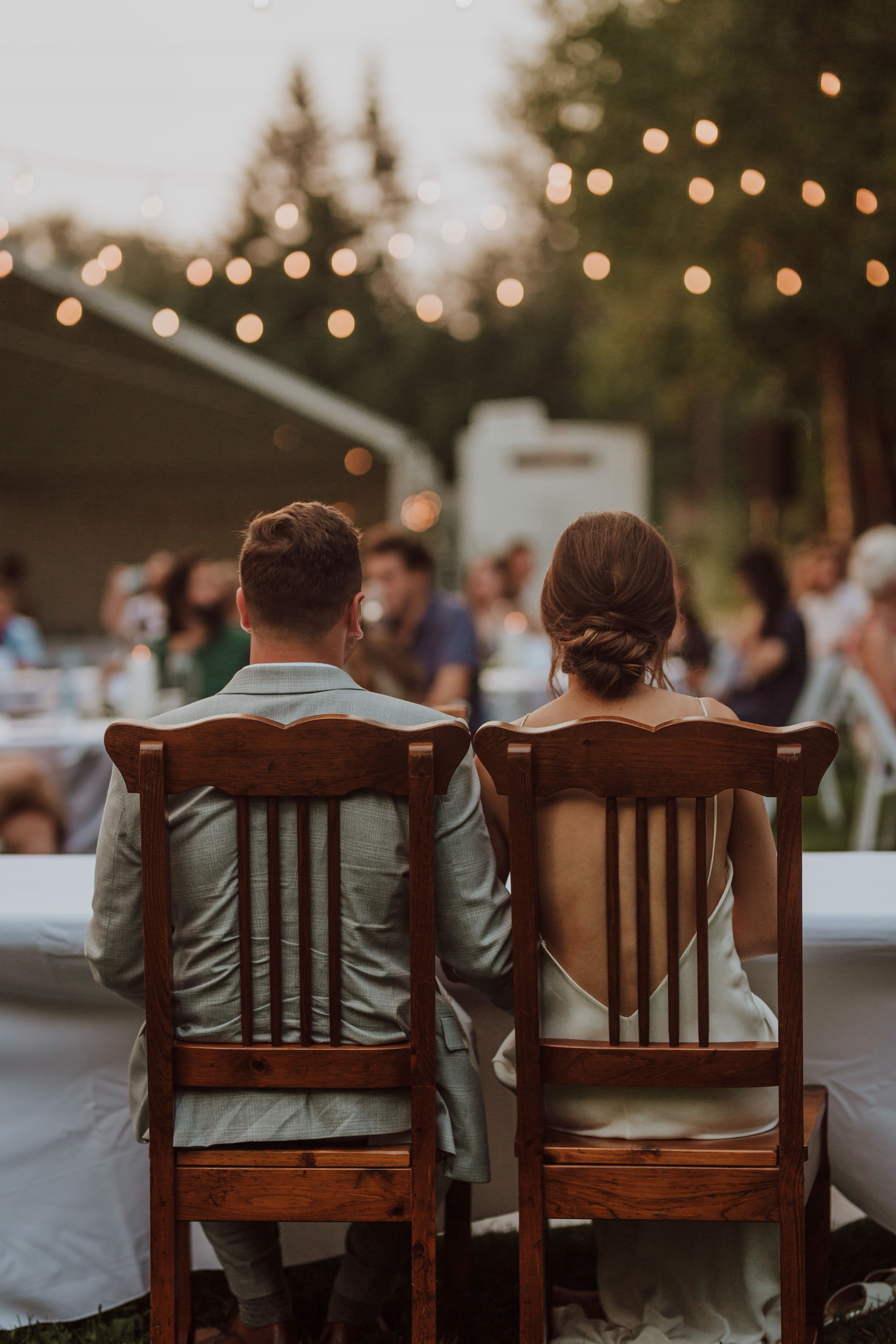
And the shape changes no one's evening more than the couple's. A sweetheart table gives them something many people want, a few quiet minutes together in the middle of a very loud day. It can also place them gently apart from the evening they made. They can see every face in the room. Everyone can see them. But they are seated with only each other.
Set into the line of a long table instead, or the inside of a serpentine curve, the bend of a crescent, the couple sits shoulder to shoulder with a grandmother on one side and an oldest friend on the other, near enough to the toast to watch the face giving it instead of a microphone in the middle distance, inside the warmth rather than facing it. They stop being the couple everyone is looking at and become, for one night, simply two more people at the table.
So the choice was never the circle against the line, and it was never which shape sits best in a photograph emptied of people. It is what the shape decides on everyone's behalf before the evening has a chance to begin: how far each guest can reach, how many people sit inside their voice, whether the person they were seated near on purpose stays eight feet away all night or turns out to be the one they are still talking to when the candles burn down. A round table can be exactly right, for the right eight people in a close room. So can a serpentine, or a horseshoe, or a plain long run down the center of a barn. Choose for reach rather than for the picture, and you will have done, in advance and invisibly, the thing the whole evening is for. No guest will ever look at the table and know it was a decision. They will only know, going home, that they actually met the person they had been hoping to.