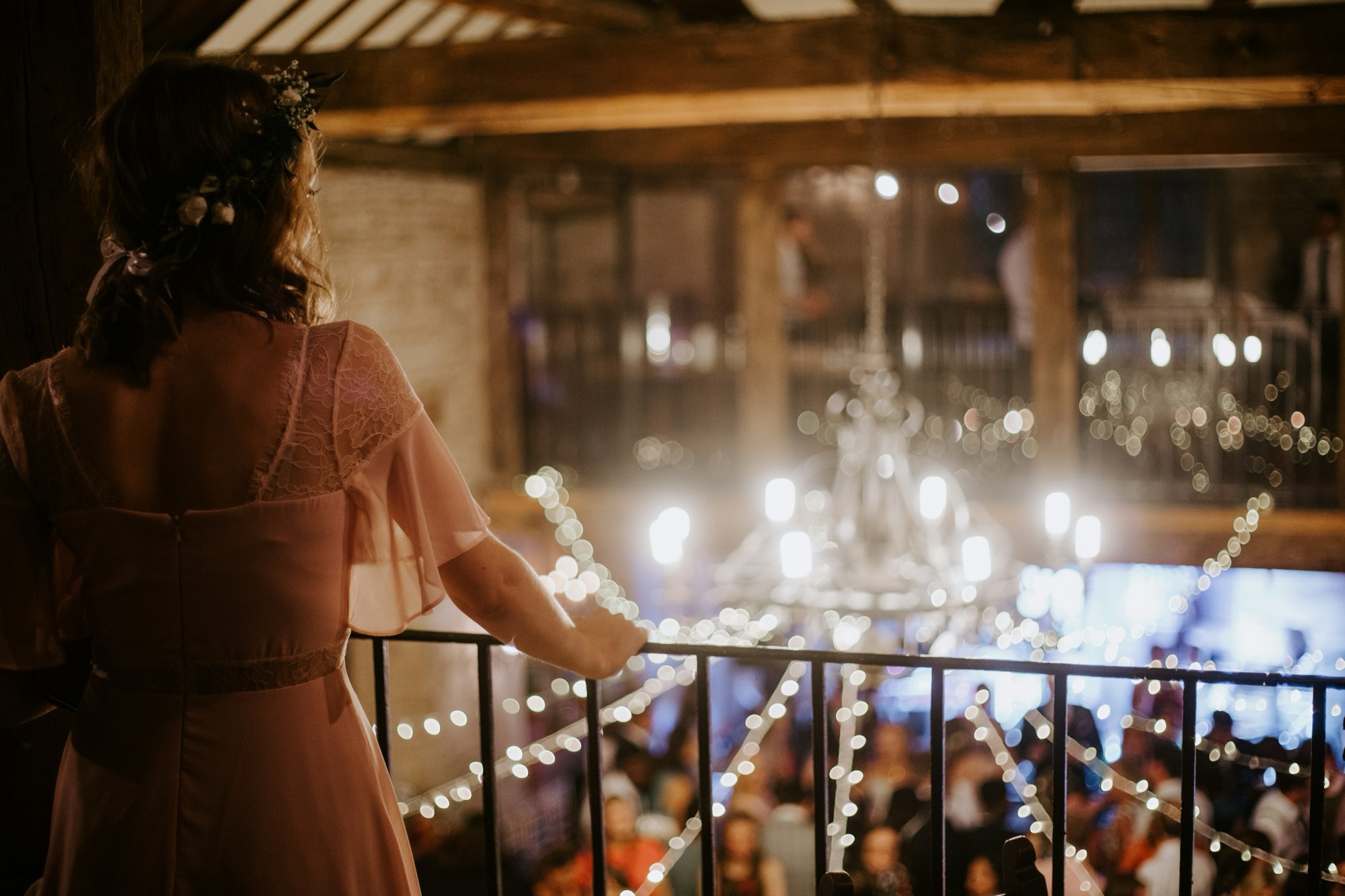
The walk between rooms
Three or four times a night, the whole room does the same thing.
Nobody hears the doors. What travels first is the conversation nearest them going quiet, and then the quiet moving outward across the cocktail hour in the second or two before anything has been announced. A woman finishes her sentence while already turning. A man sets a half-drunk glass on the ledge where drinks go to be abandoned, and by the time he has straightened up there are five more beside it. Two people arrive at the doorway together and perform the small negotiation of who goes first, which neither of them will remember doing. Behind them, a hundred and forty people who were standing in twenty separate conversations have become one crowd pointed in one direction.
A guest's wedding is a smaller event than the couple's. She arrives knowing perhaps twenty of the names. She spends the cocktail hour in a pocket of four, dinner with the nine at her table, the dancing at whichever end of the floor she was standing on when it started, and most of what she keeps comes from those small rooms inside the big one. That is not a flaw in the evening. It is what an evening is. But it means the wedding a guest attends is mostly assembled out of her own corner of it, and the exceptions are worth noticing, because there are only three or four of them. They are the moves. Sitting for the ceremony, going in to dinner, coming out to the floor. For those few minutes the whole room is doing one thing at the same time, and a guest is inside the wedding rather than inside her part of it.
Something happens to people in a crowd that is going somewhere slowly. The pace gets set by the slowest person in it, which nothing else all evening does. A hundred people wait behind a grandmother taking a stair one foot at a time, and nobody sighs, and several of them will tell you later that the night felt warm without being able to say why. The room finds out its own size in those minutes, at body scale rather than as a number on a seating plan. It gets loud in a way it has not been yet, because everyone is talking while walking and nobody is being listened to. There is a mild, contented shuffling helplessness to it. You are being carried, and you did not have to decide anything, and for the length of a corridor a wedding does the oldest hospitable thing a house can do, which is to take the next decision off you.
Nothing else in the evening is this unarranged. The chart decided who a guest sits beside; nobody decided who she walks beside. She falls in with whoever is at her elbow when the room stands up, and a surprising number of the night's real introductions happen there, at half attention, going somewhere. They are easy to begin precisely because they are easy to leave. The doorway ends them for you, with no exit required from either party, which is why people start conversations in a moving crowd that they would never sit down opposite a stranger to start. Half of them die at the threshold. The other half get resumed two hours later on the edge of the dance floor by someone who says, we were talking about this on the way in.
The move into dinner is also the only true reveal a wedding gets, and the room is not doing that work alone. Guests slow at the door. The pace of the whole crowd drops for three or four seconds, entirely without discussion, while people look up. What produces the feeling is not the room. It is two hundred people seeing the room in the same instant and hearing each other react to it, the low collective noise a crowd makes when it is surprised together, which is nothing like the sound of one person being impressed. A guest who wandered in alone twenty minutes earlier would have seen exactly the same tables and said nothing at all.
What breaks a move is letting the room out in pieces. Tables called in waves, doors opened early for whoever was standing near them, an announcement made at one end of a loud room that never reaches the other. It is usually done for sensible reasons, and it costs something, because a room released in installments arrives as several small rooms instead of one. The alternative on offer everywhere now is to fill the seam instead, to put something in the space between the parts so that no one is left with nothing to do. A guest handed something to do in the gap is a guest returned to her pocket of four. There is one seam that genuinely wants leaving alone, the hour after dinner, and that hour is not a move at all. It is a stop. The moves are the other thing entirely, and a move wants everybody in it.
Just inside the dinner room a woman steps out of the stream and stands against the wall, holding her place, watching the doorway. She is waiting for the man she was talking to at the bar, who has been caught behind the slow part of the crowd. He comes through and they pick the sentence up exactly where they set it down, and they carry it as far as the fourth table, where the cards send them to opposite ends of the room. He starts to say the rest of it anyway. She is already walking backward between the chairs, still listening, one hand up to hold him there.