What guests actually remember
Not the evening you built. The place it held for them.
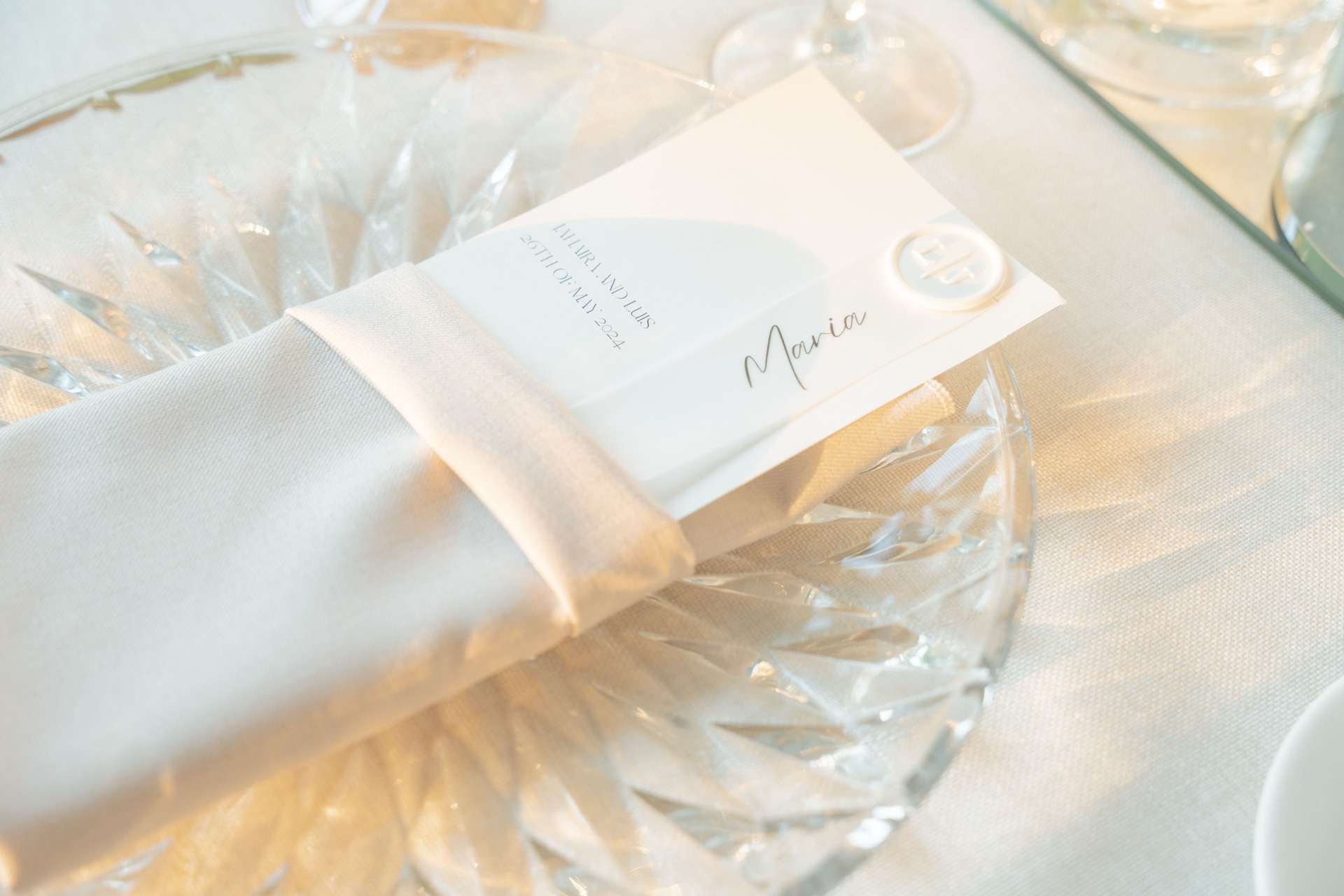
The bride's college roommate arrives alone. Fifteen years since graduation, a flight and a rental car to a state she has never been to, and the only person she knows at this wedding is the one getting married, who will be, of necessity, the least available person in the building. She has done the math on the evening ahead: a polite orbit, some weather talk with strangers, an early exit if it comes apart. Then the man at the door, whom she has never met, hears her name and lights up. Claire's roommate. She said to watch for you. At the table there is a card with her full name on it, spelled right, both names, and the seat beside hers holds the bride's oldest cousin, the one who kept turning up in the dorm stories from those years, the only other person in the room who knew the bride at nineteen. They are strangers for about four minutes. By the time the plates are cleared they have to be asked twice to quiet down for the toasts.
Ask guests, months later, what they remember about a wedding, and the answers are almost never the things the planning was about. Not the flowers, though the flowers were seen. Not the band, though the band was good. They say: they sat me next to exactly the right person. They say: someone had already thought about my mother and the steps. The groom knew who I was before I said it. What guests remember, with a consistency that should change how weddings get planned, is not the evening itself. It is the evidence that they, in particular, were expected. An invitation asks you to come. Being expected is something else entirely: it means the evening was built with you already inside it, and you can feel the difference within minutes of arriving, the way you can feel a chair that was set out for you rather than a chair that was merely not taken.
The moments guests bring up afterward are alike in one way. They are small, they are specific, and each one was plainly meant for a single person. A name known at the door. A seat that was plainly a decision and not a leftover. The chair carried to the shady end of the terrace before the grandmother had finished wondering whether to ask. The plate that arrived already matching what a guest could eat, with no conference about it, no small ceremony of accommodation to be graciously endured. None of these photograph well, and none will make the album. But each one says the same sentence, privately, to one person at a time: we knew you were coming. A wedding says it a few dozen times over the course of an evening, always quietly, and every guest it is said to keeps their copy of the sentence for years.
The beautiful things, meanwhile, are for everyone at once, and very little of what is for everyone at once ends up going home with anyone in particular. This is not a failure of the beautiful things. The room does real work: it settles people, it sets the register of the night, it tells a hundred people at once what kind of evening they have walked into. But guests admire in general and remember in particular. The centerpiece was for the room. The seat was for her. The admiration thins out somewhere on the drive home. The seat, the name at the door, the cousin: those go home with her. It is why two weddings of very different scale can trade places entirely in the minds of the people who went: the grander one survives as a lovely blur, and the smaller one, the one that knew its guests by name, stays specific for a decade.
It runs the other way too. Couples reaching for what they remember tend to go past the day's headline moments and come back with faces: the friend from three time zones away, spotted suddenly at the edge of the ceremony; a grandmother lit up during the first dance; the particular ring of people around them at eleven. The couple spends the evening being met, over and over, by everyone, and what they keep is who met them and how it felt. Which suggests the two sides of a wedding are keeping the same thing. Not spectacle. Recognition.
The reason is almost structural. Nobody attends the wedding. A hundred and fifty people attend a hundred and fifty weddings, each from a single chair, and no two of those evenings contain the same hours. The wedding that exists in planning is one object, seen from above, all at once. The wedding that is actually lived is a hundred and fifty narrow, specific evenings running in parallel, and each one has, at its center, a person who was either met by the night or left to make their own way across it. The shape of the table decides part of this; who can reach whom is arithmetic, settled in advance. But reach only creates the possibility. Someone still has to have thought: these two should find each other.
Which is where the real work turns out to live. Not in the tastings or the fittings but weeks earlier, at a kitchen table with the guest list, doing the unglamorous accounting of other people's evenings. Who is coming alone. Who will know no one. Who needs the early chair, the seat near the door, the table away from the speakers. Which two people, given four hours and adjacent seats, would matter to each other, and would never manage the introduction unassisted. It is the least visible work of the whole wedding and the only part of it that every single guest will carry out the door, because its results are not decor. Its results are the evenings themselves. And it is why the open stretch of the night matters as much as the chart: the arranged meetings begin at dinner, but that unclaimed hour is where they become real ones.
By the band's second set, the roommate and the cousin have pulled two chairs to the emptied end of the table and are fifteen years deep in the catching up. Around them the evening is doing what good evenings do, running on its own heat. She came expecting to orbit. Instead, in a room of a hundred strangers, she was never once a stranger. Somewhere between the door and the toasts the evening turned toward her, said her name, and showed her the place it had already made, and she stopped watching for the exit the way you do at a party you are only getting through. The early exit is still there if she wants it. She has not thought about it in hours. She is leaning in over the emptied end of the table, catching the cousin's next story above the band.